
We’re a design agency, which means we’re quite familiar with what goes into finding the right designer. After all, we’ve spent 10 years assessing creative skills, reviewing portfolios, and interviewing candidates.
Now, I am putting all that knowledge and experience into this article to help you understand how to hire a graphic designer.
How to Hire a Graphic Designer
- Narrow Down Your Design Needs
- Compare Hiring Options
- Explore Hiring Platforms
- Evaluate Skills & Portfolios
- Set an Interview or a Call
- Start With a Trial Project
Let’s go through each of these points in detail.
1. Narrow Down Your Design Needs
You’d assume you know exactly what you need from a designer, but I bet you don’t. A lot of times, people either overestimate or underestimate their actual design needs.
Are you a new brand? You might be thinking about getting a logo and website designed. But what about the icons, illustrations, and images for said website? Or are you just looking for someone to handle day-to-day design tasks? Then you won’t even need a full-time designer.
So start by figuring out exactly what you need help with. Make a Google Sheet detailing every design task or the scope of your project. This will also help us ensure your designer's skills match the requirements.
2. Compare Hiring Options
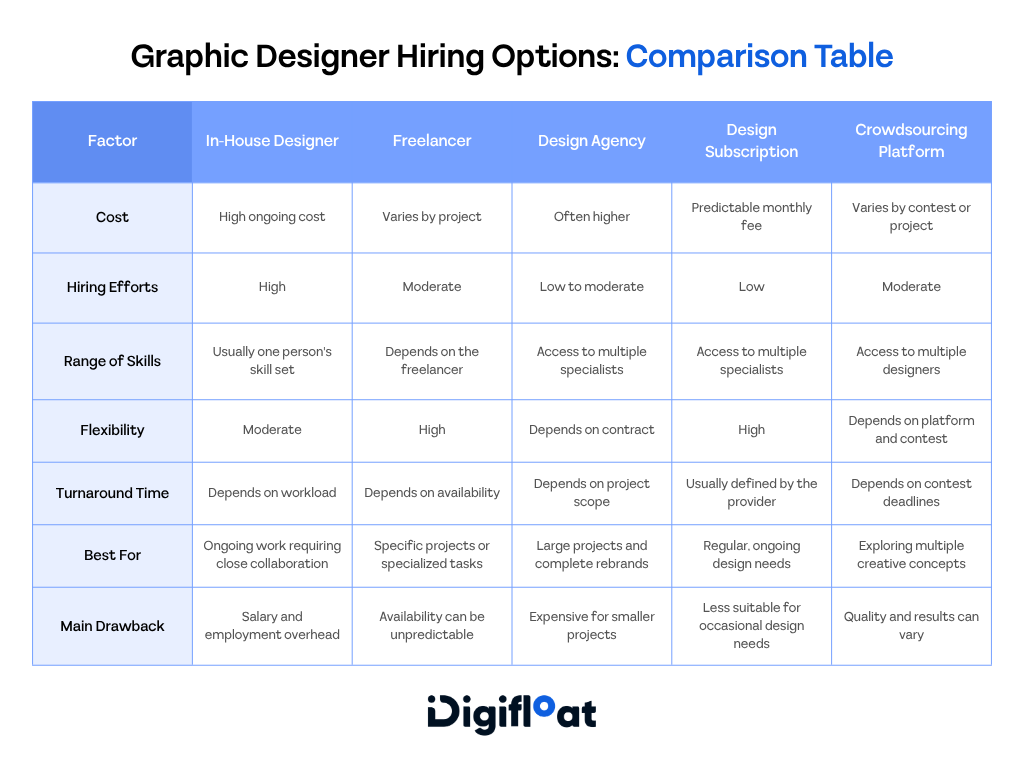
When someone says they're looking into how to hire a graphic designer, they usually picture two options: hiring someone in-house or finding a freelancer. But those aren't your only choices. There are several ways to get professional design services, and each comes with its own benefits and limitations.
I’ll explain each of these options in more detail below, but you can also use this comparison table for an overview:
In-House Designers
This is a designer who works exclusively for your company. It's one of the more traditional ways of hiring, although it has become less preferred since the COVID-19 pandemic.
Also, just to clarify, in-house doesn't necessarily mean someone who physically comes to your office. For example, we have a team of in-house designers, but Digifloat is a remote company. Our designers work regular office hours and receive employment benefits, but they just happen to work from home.
Pros of Hiring In-House Designers
I) Easier Collaboration
Your designer can attend team meetings, communicate directly with other departments, and stay involved in ongoing projects. This is particularly helpful when design is an important part of your daily operations.
II) Better Brand Familiarity
Since they're working exclusively with your company, they'll develop a deeper understanding of your brand and design preferences. You won't have to explain your visual identity every time you assign a new task.
III) More Control Over Priorities
You can decide what your designer works on and when. If an urgent task comes up, it's generally easier to rearrange their workload.
Cons of Hiring In-House Designers
I) Higher Overall Costs
You're not just paying a salary. You'll also need to account for employee benefits, paid leave, software subscriptions, equipment, and other expenses.
II) Limited Skill Sets
One designer can't be equally good at everything. Someone who's brilliant at branding might not have the same expertise in motion graphics, UI/UX, or video editing. If you have diverse needs, you’ll have to consider hiring multiple people for the job.
III) Hiring Takes Time
Finding the right candidate, conducting interviews, negotiating compensation, and onboarding them can take weeks or even months.
Freelance Designers
People often assume freelancers are only suitable for small, one-off projects. That's not true! You can hire a freelancer for an entire project, work with them on a retainer, or simply keep going back whenever you need something designed.
We've actually worked with many talented freelancers for non-design roles, so I wouldn't dismiss this option.
Pros of Hiring Freelance Designers
I) Flexibility
You won’t have to make any long-term commitments. You can hire them as per your workload.
II) Access to Specialized Skills
You can hire designers who specialize in particular areas of design as you keep moving forward. For example, you can start by hiring a logo designer, then bring in a website designer, and later work with a print designer when you need marketing materials.
III) Lower Overhead Costs
You’ll only have to pay for the agreed work without having to cover employee benefits or software licenses.
Cons of Hiring Freelance Designers
I) Unpredictability
Freelancers usually juggle multiple clients. They might not always be available on your schedule.
II) Tricky Communication
Depending on their location, schedule, and other commitments, getting timely responses or revisions might not always be easy.
Graphic Design Agencies
These are companies that provide various graphic design services in package deals. For example, you can hire an agency for a complete rebrand, and they'll take care of everything from your logo and brand identity to your website and marketing materials.
The project scope, deliverables, timeline, and pricing will all be discussed and agreed upon beforehand.
Pros of Hiring Graphic Design Agencies
I) Access to Multiple Professionals
Agencies generally have designers with different specializations. This means every small detail of your project will be handled by people with relevant expertise.
II) Project Management
You won't have to coordinate with every designer individually. Agencies often assign a project manager or account manager to oversee communication, deadlines, and deliverables. It lessens your workload as well.
Cons of Hiring Graphic Design Agencies
I) Can be Expensive
You're paying for more than just the designer's time. Agency pricing also accounts for project management, operations, and other overhead costs.
II) Less Flexibility
Most agencies work with an agreed project scope. If you suddenly decide to add five more deliverables, expect a revised quote or additional charges.III)
III) Not Ideal for Smaller Tasks
Agencies are meant for bigger projects like a complete rebrand. These aren’t a good option if you need a couple of social media graphics or other smaller design tasks.
Graphic Design Subscriptions
This is actually what we do at Digifloat! The concept is pretty simple. You pay a fixed monthly fee and can submit as many design requests as you need within the service's scope.
Think of it as having an on-demand design team without going through the traditional hiring process.
Pros of Graphic Design Subscriptions
I) Predictable Costs
You know how much you're spending on design every month. This makes budgeting easier, especially if your business needs new creative work regularly.
II) Access to Different Creative Skills
Agencies usually have designers who excel in different niches and categories. This means you can get your logo, website, social media graphics, and print materials designed by people with relevant experience, all under one roof.
III) Flexibility
You can request many kinds of designs under one subscription. Most providers even give you the option to upgrade, downgrade, pause, or cancel your plans as your requirements change.
Cons of Graphic Design Subscriptions
I) Not Ideal for Occasional Work
If you sign up for a subscription, you’ll have to pay a fixed monthly fee irrespective of your design needs. So if you only need a few graphics once a week, this option won’t be cost-effective.
II) Service Limitations
Unlimited doesn't mean absolutely everything is included. Most companies have a certain scope of work which isn’t always disclosed upfront. You’ll have to carefully check what's included in the subscription before signing up.
Design Crowdsourcing Platforms
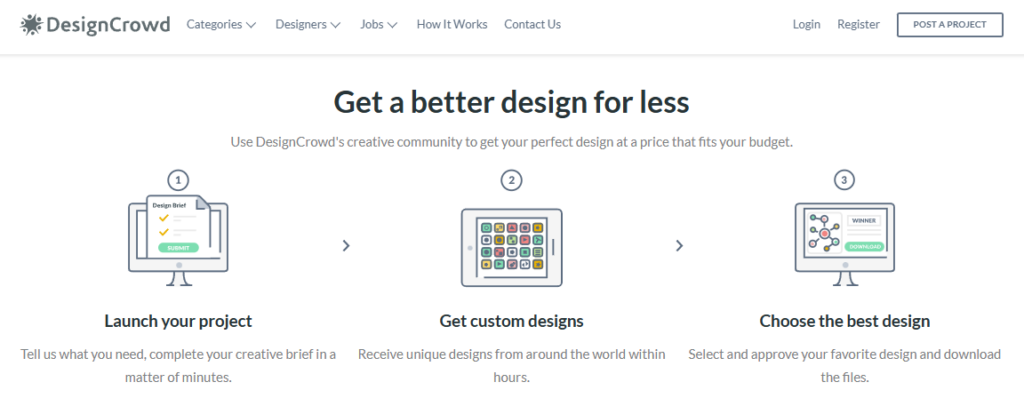
There are certain crowdsourcing platforms such as 99designs or DesignCrowd, where you can post a design brief and invite multiple designers to submit their ideas. It also works on platforms like Reddit, where you find design communities, share your requirements, and designers reach out to you directly.
I think this option is worth exploring when you have a specific, standalone project and want to see different creative interpretations.
Pros of Design Crowdsourcing Platforms
I) Multiple Creative Directions
Instead of relying on one person's interpretation of your brief, you can explore ideas from several designers. This can be helpful when you're unsure what visual direction you want.
II) Access to a Wider Talent Pool
You can discover designers from different backgrounds and locations without having to search for each candidate individually.
Cons of Design Crowdsourcing Platforms
I) Inconsistent Quality
More submissions don't automatically mean better designs. You might have to sort through several concepts before finding something that meets your expectations.
II) Time-Consuming
Finding platforms, submitting tasks, waiting for replies, reviewing submissions, and communicating changes demands a lot of time and effort.
3. Explore Hiring Platforms
Now that you know how you want to hire a graphic designer, the next question is: where do you find one? Every hiring option comes with its own set of platforms and methods.
If you're looking for an in-house designer…
Start by creating a proper job description. It should highlight the skills and experience you're looking for, and the responsibilities the designer will handle. Then post it on job platforms like LinkedIn, Indeed, or Monster.
If you're wondering how to hire a freelance graphic designer…
You’ll need to sign up for freelancing websites. The most popular ones include Upwork, Fiverr, and Freelancer. You can also check out my other article with a detailed Upwork vs Fiverr comparison. But for design work specifically, you can also check out Behance and Dribbble.
If you're wondering how to outsource graphic design services to an agency…
You need to start browsing online. Google is definitely the first place, but then you can move on to platforms like Reddit to see if other people are recommending someone. You’ll have to find genuine discussions and recommendations, then check the agencies' websites.
If you're looking for a graphic design subscription…
The starting process will look similar to hiring an agency. You can search on Google with terms such as "best unlimited graphic design services" or "best monthly graphic design service."
You'll find several brands offering different plans, services, and pricing. Take some time to compare them and see the types of design work covered, how many tasks they can handle at once, and their turnaround times.
If you're looking for a crowdsourcing platform…
You can check out 99designs and DesignCrowd. I'd say start by familiarizing yourself with each platform's process and pricing. Then figure out how to write a design brief detailing all your project requirements.
The later steps in this guide won't be entirely relevant to this option, as designers will start submitting their concepts immediately. So, you can patiently review the submissions and shortlist the ones that best match your vision.
Bonus Tip: If you need help writing a design brief, fill in your details below to get your free template.
4. Evaluate Skills & Portfolios
Now you also know where to look for a designer. But there's still a big hurdle: how do you figure out who's actually good at what they do?
I’d suggest you look at their design portfolio. It’s a great way to judge their skills and experience.
The problem is that at one glance, all portfolios look great. That’s why it’s important to dig deeper. See what kinds of projects they've worked on and whether any of them match what you've envisioned for your brand.
I always consider it a plus point when a portfolio showcases diverse designs. It shows the designer's ability to adapt to different brand styles. You should also try to spot these red flags:
- The designs all follow the same style and aesthetic.
- They tend to stick to only a few categories, like social media graphics, with little variety in their work.
- You've seen very similar designs used as templates on other platforms.
- The layouts, typography, or visual styles look dated.
- The text is difficult to read because of the font choices, size, or background colors.
- The designs look cluttered, with too many elements competing for attention.
And don't forget to check their technical skills. Depending on your requirements, you might need someone proficient in Adobe Illustrator, Photoshop, Figma, InDesign, or other design tools.
Then you move on to their past testimonials. Do not rely solely on what's mentioned on their website. You should check third-party platforms like Trustpilot, Google Reviews, or Reddit to see what actual clients have to say about working with them.
Remember that a single negative review isn't necessarily a dealbreaker. You need to look for a pattern of similar complaints and how the person/business responds to negative feedback.
5. Set an Interview or a Call
Once you've shortlisted a few designers, it's time to have a conversation with them. This is your chance to understand how they work, communicate, and approach projects before making a decision.
If you are hiring in-house, the interview can take place in your office. But for other options, you can schedule an online video interview. Even subscriptions that are usually more direct (you just sign up and get started) offer options to opt for a call with their team.
Make a list beforehand of everything you need to ask them. It could be about their previous experience, work process, typical turnaround time, revision policy, communication preferences, or pricing. Also make sure you are communicating your requirements properly so there are no misunderstandings later.
6. Start With a Trial Project
This is perhaps the most important yet often overlooked step in hiring a graphic designer. And honestly, it's also where I feel graphic design subscriptions have an advantage. Many providers offer free trials or money-back guarantees. This means you can try their service, get a few designs made, and judge the quality before fully committing. It's a relatively low-risk option.
When it comes to freelancers and traditional design agencies, it’s not so simple. You can always ask if they're willing to work on a small paid pilot project before moving forward. But they might not be open or available. So, you’ll have to make your decision based on their portfolio, experience, and initial conversations.
However, you can still test the waters with other hiring options. If you're hiring an in-house designer, for example, you could give them a small, paid test assignment, such as a simple infographic using an infographic design brief template. This gives you a chance to assess their skills, creativity, and ability to follow a brief before making a long-term commitment.
Summing Up: How to Hire a Graphic Designer
Learning how to hire a graphic designer takes time and effort. You need to understand your design needs, explore your hiring options, compare candidates, and make sure their skills and work process align with your expectations.
But if you want to skip the hassle and get great designs, you should consider hiring Digifloat. We'll give you a dedicated design team and access to 110+ creative services all at one predictable monthly fee. Explore our unlimited graphic design packages to find the right fit for your creative needs.




0 Comments